 listicle
Is Invisalign Worth the Cost in 2026? An Honest Review
Table of Contents
- How Much Does Invisalign Cost in Ontario in 2026?
- Invisalign vs Traditional Braces Cost Comparison
- What Is the Average Length of Invisalign Treatment?
- Invisalign Payment Plans and Financing Options in Ontario
- The Costs Nobody Talks About: Retention and Long-Term Maintenance
- The Psychological and Social Return on Your Smile Investment
- DIY Aligners vs Professional Invisalign: What the Savings Actually Cost You
- Conclusion: Weighing the Real Value of Invisalign in 2026
- Frequently Asked Questions
Last Updated: September 12, 2026
How Much Does Invisalign Cost in Ontario in 2026?
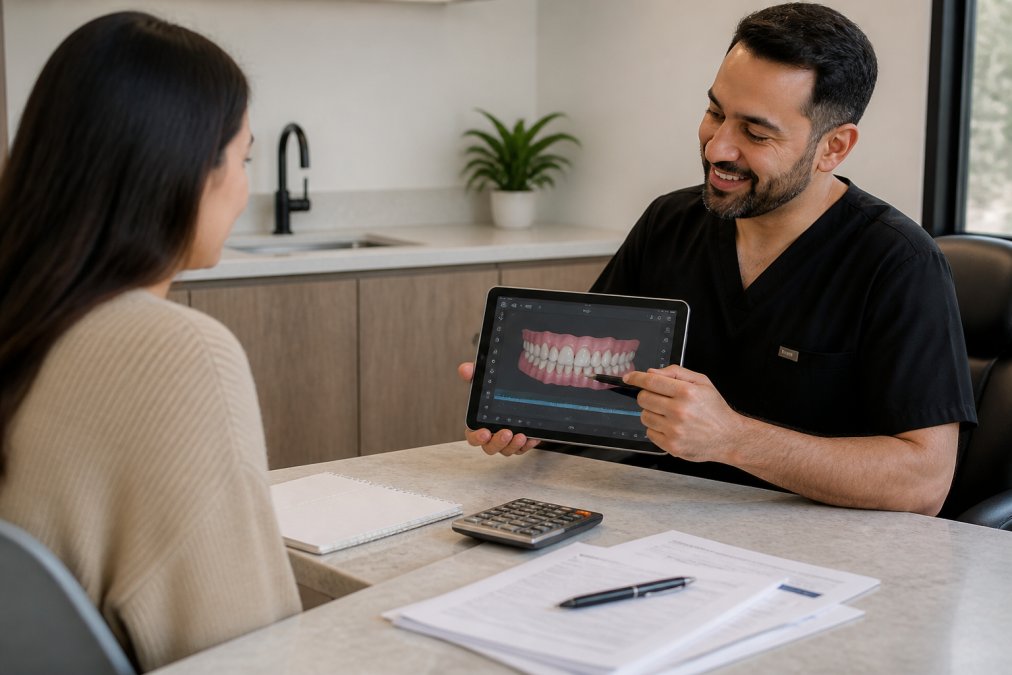
Asking is Invisalign worth the cost in 2026 starts with one honest admission: nobody can quote you a single flat fee, because clear aligner pricing is built around your specific case. At ALLDENT Family Dental, we build every Invisalign quote from a digital scan and a personalized treatment plan, not a generic price sheet. The Canadian Dental Association notes that orthodontic fees reflect case complexity, the number of aligner stages, and the provider's clinical plan, so two patients in the same chair can pay very different totals. Canadian Dental Association on orthodontic care
Treatment Tiers and What Each One Covers
Invisalign isn't one product; it's a family of tiers. Invisalign Express is the most basic, limited to 7 stages for minor relapse or slight front-tooth movement. Invisalign Lite covers minor crowding or spacing with up to 14 stages. Invisalign Comprehensive handles complex bite issues and significant crowding, with unlimited aligner sets and refinement trays.
| Tier | Aligner Stages | Best For | Refinements |
|---|---|---|---|
| Express | Up to 7 | Minor relapse, slight front-tooth movement | Limited |
| Lite | Up to 14 | Minor crowding or spacing | Limited |
| Comprehensive | Unlimited | Complex bite issues, significant crowding | Included |
The tier your case lands in is the single biggest driver of what you pay. A short Express plan and a multi-year Comprehensive plan are not comparable purchases.
Invisalign vs Traditional Braces Cost Comparison
Traditional braces and Invisalign are closer in price than most people assume. The real difference comes down to case complexity and visit frequency, not bracket material. Fixed braces involve more adjustment appointments; clear aligners shift more work to your daily wear time.
| Factor | Traditional Braces | Invisalign |
|---|---|---|
| Visibility | Metal or ceramic brackets | Clear, discreet aligners |
| Removability | Fixed | Removable for eating and brushing |
| Oral hygiene | Harder to clean around brackets | Easier to maintain |
| Visit frequency | Regular adjustments | Fewer in-person checks |
| Complex cases | Strong fit | Comprehensive tier handles most cases |
If your case is complex, braces may still be the more predictable route. For mild to moderate crowding, clear aligners typically deliver comparable results with less chair time.
What Is the Average Length of Invisalign Treatment?
The average length of Invisalign treatment ranges from about 6 months for minor corrections to 18-24 months for complex cases. Wear time is the variable you control: aligners only work when they're in your mouth. Most providers recommend 20-22 hours per day, removing them only to eat, drink anything but water, and brush.
Compliance matters more than the aligner brand. A patient who wears trays as directed finishes on schedule; one who leaves them out for long stretches ends up with refinement trays and extra months.
Invisalign Payment Plans and Financing Options in Ontario
Most clinics offer in-house payment plans that spread the cost over the treatment period, plus third-party dental financing such as Dentalcard, which covers the full cost upfront and lets you repay in monthly installments. Third-party financing typically carries interest, so you repay more than the treatment price; in-house plans are often interest-free but require a larger upfront deposit.
Using HSA or PHSP for Orthodontic Costs
If you're self-employed or have a private health plan, a Health Spending Account or Private Health Services Plan lets you pay for orthodontic services with pre-tax dollars, provided the plan meets Canada Revenue Agency requirements. Canada Revenue Agency guidance on health spending accounts This can reduce your real out-of-pocket burden on a high-cost procedure. Eligibility and setup vary, so confirm the details with your plan administrator before you rely on it.
The Costs Nobody Talks About: Retention and Long-Term Maintenance
The treatment plan is not the end of the bill. Every orthodontic patient, braces or aligners, needs retainers afterward, and retainers are a separate cost. This is the line item most quotes leave out, and the biggest reason a "worth it" calculation goes wrong.
The two retainer types and how they fail
There are two main retention options:
- Fixed wire retainer, a thin bonded wire glued behind the front teeth, usually the lower incisors and sometimes the upper. It is invisible and works 24/7 because you cannot remove it. The trade-off: it traps plaque, needs careful flossing, and can detach if you bite into something hard. A re-bond is a small chair-side procedure, but still a visit and a fee.
- Removable clear retainer, a vacuum-formed or 3D-printed tray, often worn full-time for the first few months and then nights only. It is easy to clean and easy to lose. Most practitioners find removable retainers need replacement every 1-3 years depending on wear, cleaning habits, and grinding (PubMed).
Many orthodontists recommend a combination: a fixed wire plus a removable night retainer, so if one fails the other still holds the teeth. That is more protection, but also two costs instead of one.
What retention actually costs over a lifetime
Retention is not a one-time purchase. It is a recurring subscription on your smile:
| Retention item | Typical replacement cycle | Why it recurs |
|---|---|---|
| Removable clear retainer (single arch) | Every 1-3 years | Cracks, discoloration, warping, loss |
| Removable clear retainer (both arches) | Every 1-3 years | Same, doubled |
| Fixed wire retainer | Re-bond as needed | Detachment, breakage, decay under the wire |
| Retainer cleaning supplies | Ongoing | Tablets, cases, brushes |
| Replacement impressions or scans | With each new retainer | Fit must be re-verified |
A patient who lives another 40 years after treatment may replace retainers a dozen times or more, a meaningful lifetime figure almost never included in the headline Invisalign quote.
The relapse mechanism you are actually paying to prevent
Teeth do not stay put because the bone around them is static. The periodontal ligament remodels continuously, and the pressure of the tongue, lips, and cheeks pushes teeth forward and inward for life. That is why the American Association of Orthodontists and Canadian dental bodies treat retention as indefinite. The first year after treatment is the highest-risk window, but relapse can happen at year five or fifteen if retention stops.
This is the real cost of skipping retainers: not the retainer you did not buy, but the second round of active treatment you now need. Re-treatment is almost always more expensive than the original plan because relapse cases are harder to move than virgin teeth.
How to budget for retention from day one
Ask three questions before you sign:
- Is the retainer included in the quoted fee, or billed separately? Some clinics bundle the first set; many do not.
- How many replacement retainers are included, and at what price after that? Get the number in writing.
- Is the retention phase monitored, and for how long? A retention check at 6 months, 12 months, and then annually is a common pattern.
If you build a modest annual retention line into your budget from the start, the post-treatment years become the predictable cost of keeping the result you paid for.
The Psychological and Social Return on Your Smile Investment
The return on Invisalign is not only clinical. It is also social and psychological, and for many adult patients that is the part that decides whether the cost was worth it.
What the research on smile and confidence actually shows
Psychologists who study facial appearance have long observed that teeth are one of the first features people notice and one of the few adults can change relatively quickly. Studies on smile aesthetics consistently find that people with straight, white teeth are rated as more attractive, more successful, and more approachable in first-impression experiments, even when raters do not realize teeth are driving the judgment. That explains why so many patients describe the change as bigger than the teeth.
The specific moments patients say changed
When adults describe why treatment was worth it, the same scenarios recur:
- Photos. Patients who spent years angling their head or hiding behind others in group shots start appearing in them again.
- Work. Client-facing roles, interviews, presentations, and video calls put your face at the center of the interaction. Patients in sales, teaching, law, and media often describe a measurable drop in self-monitoring.
- Dating and social settings. Smiling freely without covering your mouth is a small behavior with a large effect on how open you appear to others.
- Everyday speech and eating. For patients with crowding or bite issues, the functional relief, biting into an apple, speaking without adjusting, is part of the return too.
Why Invisalign specifically changes the social math
Traditional braces are visible. For teenagers that is often fine, but for adults in professional or social settings, visible brackets change how you are perceived during treatment, not just after. Clear aligners are removable and near-invisible at conversational distance, so you are not "the person with braces" for 18 months, just you, quietly straightening your teeth.
That matters for the ROI calculation because it removes one of the main reasons adults delay treatment. The cost of waiting, years of not smiling in photos, of holding back in meetings, is real, even if it never appears on a quote.
How to weigh a non-financial return honestly
A useful exercise before you commit:
- Write down three specific moments where your teeth currently affect your behavior, a meeting, a photo, a date, a presentation.
- Estimate how often those moments happen in a year.
- Ask what it would be worth to you to stop managing those moments.
If the number you land on is in the same range as the treatment cost spread over the years you will have the result, the psychological return is doing real work in the decision. If not, it may mean a shorter, cheaper tier is the right fit, or that the money is better spent elsewhere right now.
The honest caveat
Invisalign does not treat anxiety, and it does not fix everything about how you feel in a room. What it can do is remove one specific, fixable source of self-consciousness. For patients who have carried that source for years, the relief is often disproportionate to the physical change, the part of the return no pricing table can capture.
DIY Aligners vs Professional Invisalign: What the Savings Actually Cost You
Mail-order aligner kits promise straight teeth at a fraction of the price, and the gap looks tempting. What they skip is the diagnosis. A qualified orthodontist or dentist assesses your bite, roots, and jaw before treatment, and that assessment separates a safe plan from a guess. Moving teeth without proper imaging and supervision can cause problems that cost far more to fix.
Professional Invisalign includes 3D imaging, a digital scan, attachments and buttons where needed, and refinement trays to correct what the first round missed. DIY kits typically offer none of that. The savings are real; so is the risk.
Conclusion: Weighing the Real Value of Invisalign in 2026
The question of is invisalign worth the cost in 2026 depends on your case, your budget, and how much a straighter smile matters to you. The sticker price is only part of the picture: factor in your tier, wear-time compliance, financing interest, and retention costs. For a clear answer instead of a range, the only reliable path is an in-person assessment with digital imaging.
At ALLDENT Family Dental, we build personalized treatment plans around your goals, use modern digital imaging for precise planning, and offer a calm, welcoming environment for patients who get anxious at the dentist. Book an appointment to find out exactly where your case falls and what it will actually cost.
Frequently Asked Questions
What is the average cost of Invisalign in 2026?
The Invisalign cost in Ontario in 2026 depends on the complexity of your case and which treatment tier you need. Express handles 7 stages, Lite covers up to 14 stages, and Comprehensive includes unlimited aligners for complex cases. Because there is no single price, the best way to get an accurate figure is to book a consultation for a digital scan and personalized quote. Many clinics also offer payment plans to spread the cost.
Does private dental insurance cover Invisalign in Ontario?
Many private dental insurance plans in Ontario cover part of the cost of clear aligners, but coverage varies widely. Some plans classify orthodontic treatment as a separate benefit with a lifetime maximum, while others exclude adult orthodontics entirely. Check your specific policy for orthodontic details and annual limits. If you have a Health Spending Account or PHSP through your employer, you may be able to pay for Invisalign with pre-tax dollars, which reduces the effective cost.
What factors influence the total price of Invisalign treatment?
The total price depends on case complexity, the number of aligner stages required, whether you need attachments or elastics, and the provider's expertise. Complex bite issues or significant crowding usually require the Comprehensive tier, which costs more than Lite or Express. Your location also matters, as fees vary by region. Additionally, the retention phase after treatment involves retainer costs that are often not included in the initial quote.
Is Invisalign cheaper than traditional braces?
In many cases, Invisalign and traditional braces cost about the same. Metal braces may have a lower starting price for simple cases, but ceramic or lingual braces can cost as much as or more than Invisalign. The Invisalign vs traditional braces cost comparison should also factor in comfort, appearance, and convenience. Clear aligners are removable, which makes oral hygiene easier and may reduce the risk of decalcification during treatment.
How long does Invisalign treatment usually take?
The average length of Invisalign treatment ranges from 6 to 18 months for most patients, though complex cases can take longer. Express and Lite tiers are designed for minor corrections and often finish in under a year. Comprehensive cases involving significant movement may take 18 months or more. Your compliance with wear time (20 to 22 hours per day) directly affects how closely you stay on schedule. Refinement trays may add a few weeks at the end.