 how-to
What to Expect at the Dentist: A Complete Guide
Table of Contents
- What Happens During a Dental Exam, Step by Step
- Dental Cleaning, Scaling, and Polishing Explained
- How Long Is a Dental Checkup, Really?
- Dental Anxiety Management Techniques That Actually Help
- Questions to Ask Your Dentist During an Exam
- Insurance, Costs, and What to Bring to Your Dental Exam
- Post-Appointment Care and Your Treatment Plan
- Conclusion
Last Updated: August 18, 2026
What Happens During a Dental Exam, Step by Step
A dental exam is a structured, multi-step process designed to assess your oral health comprehensively. Many patients arrive uncertain about what's coming, and that uncertainty often drives anxiety more than the appointment itself. Knowing the steps in advance changes everything.
A standard dental exam typically covers four core phases: reviewing your health history, a comprehensive oral evaluation, diagnostic imaging, and an oral cancer screening.

Patient History and Oral Health Review
Your appointment begins before anyone looks in your mouth. Your dental hygienist or dentist will review your patient history, including medications, recent health changes, allergies, and previous dental treatments. Certain medications affect saliva production and gum health. Conditions like diabetes and heart disease have direct connections to periodontal disease.
New patients fill out a health questionnaire; returning patients confirm any changes since their last visit. This is the right moment to mention symptoms you've noticed: sensitivity, pain, bleeding gums, or changes in your bite.
Comprehensive Oral Evaluation: Teeth, Gums, and Jaw
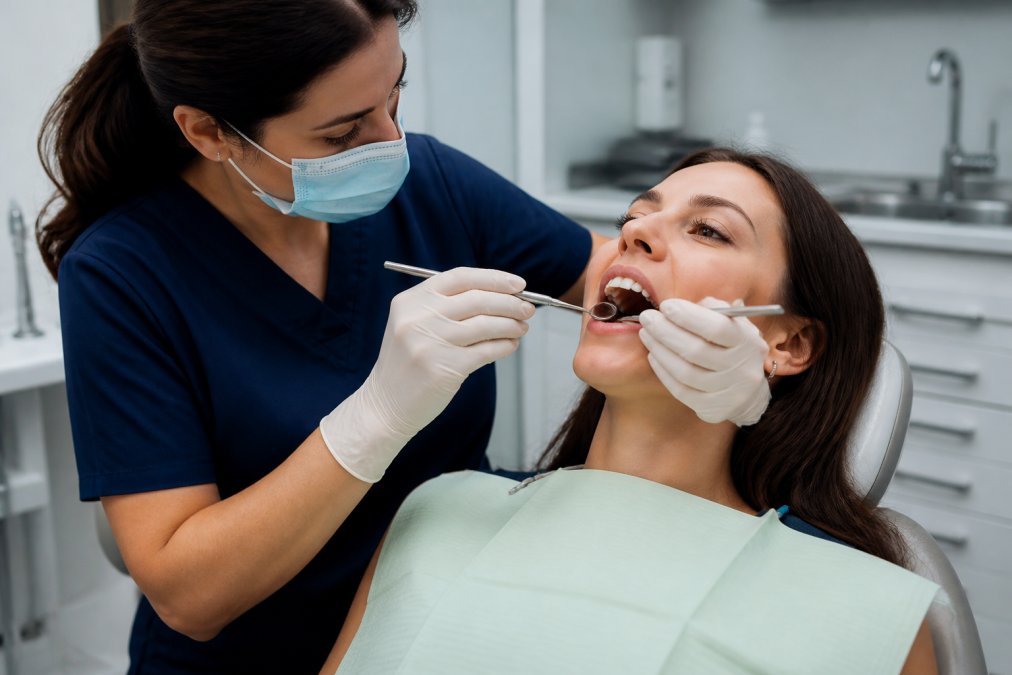
Your dentist will examine each tooth individually, checking for decay, cavities, cracks, and wear. Gum health gets equal attention. The hygienist uses a small probe to measure pocket depth between teeth and gums. Shallow, healthy pockets typically measure 1 to 3 millimetres; deeper measurements indicate gingivitis or advanced periodontal disease.
Your dentist will also assess your bite, check for malocclusion, and examine the jaw joint for clicking, popping, or tenderness. Soft tissues inside the mouth, including the tongue, cheeks, and palate, are inspected for abnormalities.
Digital X-Rays and Diagnostic Imaging
Modern digital X-rays expose patients to significantly less radiation than older film-based systems, with images appearing on screen within seconds. According to Health Canada's guidance on dental radiography safety, dental X-rays are considered safe when used appropriately with proper protective measures. Your dentist uses X-rays to detect decay between teeth, assess bone levels, identify infections, and spot issues invisible to the naked eye.
Oral Cancer Screening: Face, Neck, and Soft Tissues
Oral cancer screening is a standard part of a thorough dental exam. Your dentist will visually inspect and gently palpate the lymph nodes in your neck and jaw, looking for swelling, lumps, or unusual firmness. Inside the mouth, they'll examine the tongue, floor of the mouth, gums, and cheeks for lesions, discoloration, or abnormalities.
Early detection is the most important factor in oral cancer outcomes. As the Canadian Cancer Society's oral cancer resources notes, many early-stage oral lesions are painless, which is why professional examination is necessary.
Dental Cleaning, Scaling, and Polishing Explained
Most patients think of dental cleaning as the polishing step at the end. Professional cleaning, known clinically as prophylaxis, involves several distinct steps, with the most important one happening before polishing begins.
Removing Plaque, Tartar, and Calculus
Plaque is a soft, sticky film of bacteria that forms on teeth throughout the day. When not removed through brushing and flossing, it hardens into tartar, also called calculus, which cannot be removed at home. Calculus below the gumline is a primary driver of gingivitis and, left untreated, periodontal disease.
Scaling removes calculus from tooth surfaces and below the gumline using hand instruments or an ultrasonic scaler. The ultrasonic tool uses high-frequency vibrations and water spray to break up deposits. If you have significant buildup, the hygienist may need more time in this phase, which is completely normal.
Polishing and Fluoride Treatment
After scaling, your teeth are polished using a rotating rubber cup and mildly abrasive paste. Polishing removes surface stains and leaves tooth surfaces smooth, making it harder for plaque to adhere between visits.
Fluoride treatment is often offered at the end of a cleaning, particularly for children and adults with higher decay risk. A fluoride gel or varnish is applied to strengthen tooth enamel and help remineralize early areas of decay. Your dentist will advise whether fluoride treatment is appropriate based on your individual risk profile.
How Long Is a Dental Checkup, Really?
A routine dental checkup, including cleaning, typically takes 60 to 90 minutes for an adult with generally good oral health. This estimate shifts based on several factors.
Patients who haven't had a cleaning in over a year often have more calculus buildup, requiring longer scaling. New patients require more thorough initial assessment and complete charting. X-rays add 10 to 15 minutes. Patients with periodontal disease may require scaling and root planing rather than standard prophylaxis.
For children, a routine checkup can often be completed in 45 minutes, depending on cooperation level and age.
| Appointment Type | Typical Duration | Key Variables |
|---|---|---|
| Routine adult checkup + cleaning | 60-90 minutes | Calculus buildup, X-rays required |
| New patient comprehensive exam | 75-90 minutes | Full charting, health history, imaging |
| Child's first dental visit | 30-45 minutes | Cooperation level, age |
| Periodontal maintenance visit | 60-90 minutes | Disease severity, number of sites |
| Emergency exam (pain assessment) | 30-60 minutes | Complexity of presenting issue |
Book your appointment when you have adequate time. Rushing adds to anxiety and may pressure your dentist to abbreviate the assessment.
Dental Anxiety Management Techniques That Actually Help
Dental anxiety is one of the most common reasons people delay or avoid dental care. For many, it's rooted in previous painful experiences, loss of control, or unfamiliar sounds and sensations.

Tell your dental team before you sit down. When the team knows you experience anxiety, they can adjust communication, explain each step, and check in throughout. Silence during a procedure is a major fear driver and entirely avoidable.
Establish a stop signal. Agreeing on a hand signal that pauses the procedure gives you control. Many patients never use it, but knowing it's available reduces tension significantly.
Request a slower pace for injections. Most discomfort from local anaesthetic comes from delivery speed, not the needle itself. A slow injection is noticeably more comfortable.
Bring noise-cancelling headphones. Dental instrument sounds trigger anxiety for many patients. Listening to music or a podcast is widely accepted at modern clinics.
Schedule strategically. Morning appointments work better for anxious patients, leaving less time for anticipatory worry.
Questions to Ask Your Dentist During an Exam
Most patients leave without asking a single question. The dental exam is the best time to get personalized information about your oral health.
Worth asking:
- What is my gum health score, and what does it mean? Ask for your periodontal pocket measurements explained clearly.
- Are there areas I'm consistently missing when I brush? Your hygienist can show exactly where plaque accumulates.
- Do I need X-rays today, and why? Understanding the clinical reason helps you make informed decisions.
- What's my actual cavity risk, and what's driving it? Diet, dry mouth, and acidic beverages affect decay risk differently.
- Is there anything I should watch between now and my next appointment? Useful if a tooth or gum area is being monitored.
- What does my treatment plan involve, and what's the priority order? Understanding which is urgent versus elective helps you plan.
Insurance, Costs, and What to Bring to Your Dental Exam
Financial uncertainty is one of the most common reasons people delay dental care. Understanding what to bring and what to expect reduces that barrier.
What to bring:
- Your provincial health card
- Your dental insurance information, including group number and member ID
- A list of current medications (including supplements)
- Any previous dental records or X-rays if you're a new patient
- Your referral letter if referred by another provider
Understanding your coverage: Dental insurance in Canada varies significantly by plan. Most private plans cover a higher percentage of preventive care than restorative work. Many plans have annual maximums and waiting periods for certain treatments. The Canadian Dental Association's patient resources on insurance offers guidance on understanding plan terminology.
For patients covered under the Canadian Dental Care Plan (CDCP), visit the Government of Canada's Canadian Dental Care Plan information for current eligibility criteria and covered services.
Pricing varies by clinic, treatment complexity, and fee guide agreements. Ask the front desk for a pre-treatment estimate before any work begins.
Post-Appointment Care and Your Treatment Plan
What you do after your dental exam affects both your comfort and outcomes.
Immediately after a cleaning: Your gums may be mildly tender if significant scaling was performed. This is normal and typically resolves within 24 to 48 hours. Warm saltwater rinses help. Avoid very hot or cold foods if you notice sensitivity.
After fluoride treatment: Most fluoride varnishes require avoiding eating or drinking for 30 minutes to allow absorption. Your hygienist will give specific instructions.
Your treatment plan: If issues are identified, you should receive a written treatment plan outlining what needs to be done, in what order, and associated costs. Review it carefully and ask which items are urgent versus elective. Don't feel pressured to schedule everything at once.
Between appointments: Brush twice daily with fluoride toothpaste, floss once daily, and limit acidic and sugary foods between meals. As the Canadian Dental Hygienists Association's oral health guidelines emphasizes, professional cleanings are most effective when paired with consistent home oral hygiene.
Routine dental exams are typically recommended every six months, though your dentist may recommend different frequency based on your individual gum health, decay risk, and overall oral health status.
Putting off a dental exam because of anxiety, cost uncertainty, or not knowing what to expect is understandable. But the longer the gap between visits, the more likely minor issues become significant ones. ALLDENT Family Dental offers comprehensive exams, digital imaging, and personalized treatment plans in a calm, patient-centered environment, with same-day emergency care available when you need it most. Book your appointment and take the first step toward oral health that doesn't require guesswork.
Frequently Asked Questions
Should you brush your teeth before going to the dentist?
Yes, brushing before your appointment is good practice. It removes loose food debris and shows your dental team your normal oral hygiene routine. Avoid skipping brushing out of embarrassment, your dentist and dental hygienist are there to help, not judge. Flossing beforehand is also a good idea. That said, do not brush aggressively right before your dental exam, as inflamed or sensitive gum tissue is still useful clinical information for your dentist.
How long does a standard dental checkup take?
A routine dental exam and cleaning typically takes between 45 and 90 minutes for most adults. First-time patients usually need closer to 90 minutes because the appointment includes a full patient history, comprehensive oral evaluation, and often diagnostic imaging. Follow-up hygiene appointments with no new concerns can run closer to 45 to 60 minutes. Children's appointments are generally shorter. Your dental office can give you a more precise estimate when you book.
Do I need to bring my dental insurance information to my first appointment?
Yes, bring your dental insurance card and any plan documents you have. Knowing your coverage details in advance helps the front desk team verify your benefits and explain what your plan covers before treatment begins. If you are covered under the Canadian Dental Care Plan (CDCP), bring your CDCP information as well. If you are uninsured, ask the office about payment options before your appointment so there are no surprises.
What can a dentist tell by looking in your mouth?
A dentist can identify a wide range of conditions during a visual exam. These include tooth decay and cavities, signs of gum disease such as gingivitis or periodontal disease, plaque and tartar buildup, malocclusion (bite problems), worn or cracked enamel, and early signs of oral cancer in the soft tissues. Combined with digital X-rays, a comprehensive oral evaluation gives your dentist a detailed picture of your overall oral health that goes well beyond what is visible to the naked eye.
This article was written using GrandRanker