 ultimate-guide
Modern Dental Solutions for Adults: 2026 Guide
Table of Contents
- What Modern Dental Solutions for Adults Actually Include
- Cosmetic Dentistry Options for Adults
- The Benefits of Digital Dentistry in Everyday Practice
- Minimally Invasive Dental Procedures: Less Drilling, Faster Recovery
- Restorative Options: Implants, Bridges, and Full Mouth Reconstruction
- Managing Dental Anxiety With Modern Comfort Techniques
- Costs, Insurance, and Planning Your Treatment
- Long-Term Maintenance for Adult Oral Health
- Frequently Asked Questions
Last Updated: September 11, 2026
What Modern Dental Solutions for Adults Actually Include
Modern dental solutions for adults combine digital diagnostics, minimally invasive treatment, and comfort-focused care into a single plan built around each patient's goals. This approach can change the experience for adults who once dreaded the chair. Instead of reacting to problems, today's dentistry catches them earlier and treats them more gently. (Source: clear aligners, including Invisalign)
Modern dental solutions use digital imaging, biocompatible materials, and minimally invasive techniques to diagnose and treat oral health issues with greater precision and less discomfort than traditional methods.
How Care Has Changed in the Last Decade
The biggest shift is diagnostic: digital radiography replaces film X-rays with instant, lower-dose sensors, and intraoral cameras let you see what your dentist sees on a chairside monitor.
Treatment planning has changed too: plans now often start with a 3D scan rather than impressions, and procedures that once took multiple visits can often be completed in one.
A common mistake is assuming "newer" always means "more expensive." In practice, earlier detection can mean smaller, less costly interventions later.
Cosmetic Dentistry Options for Adults
Cosmetic dentistry for adults covers everything from subtle whitening to full smile transformation. Three options dominate most conversations: porcelain veneers, professional whitening, and clear aligners.
Veneers, Whitening, and Clear Aligners Compared
| Option | Best For | Typical Visits | Key Trade-Off |
|---|---|---|---|
| Porcelain veneers | Chipped, stained, or uneven front teeth | 2-3 | Irreversible enamel reshaping |
| Professional whitening | Yellowing from coffee, wine, or age | 1 | Temporary sensitivity possible |
| Clear aligners | Crowding, spacing, mild malocclusion | Ongoing | Requires 20-22 hours of daily wear |
Veneers reshape the front of the smile permanently. Whitening brightens existing enamel without altering tooth structure. Clear aligners, including Invisalign, move teeth gradually using removable trays (the American Dental Association).
What most guides miss is that these aren't mutually exclusive. Many adults combine alignment first, whitening second, and veneers only where needed.
The Benefits of Digital Dentistry in Everyday Practice
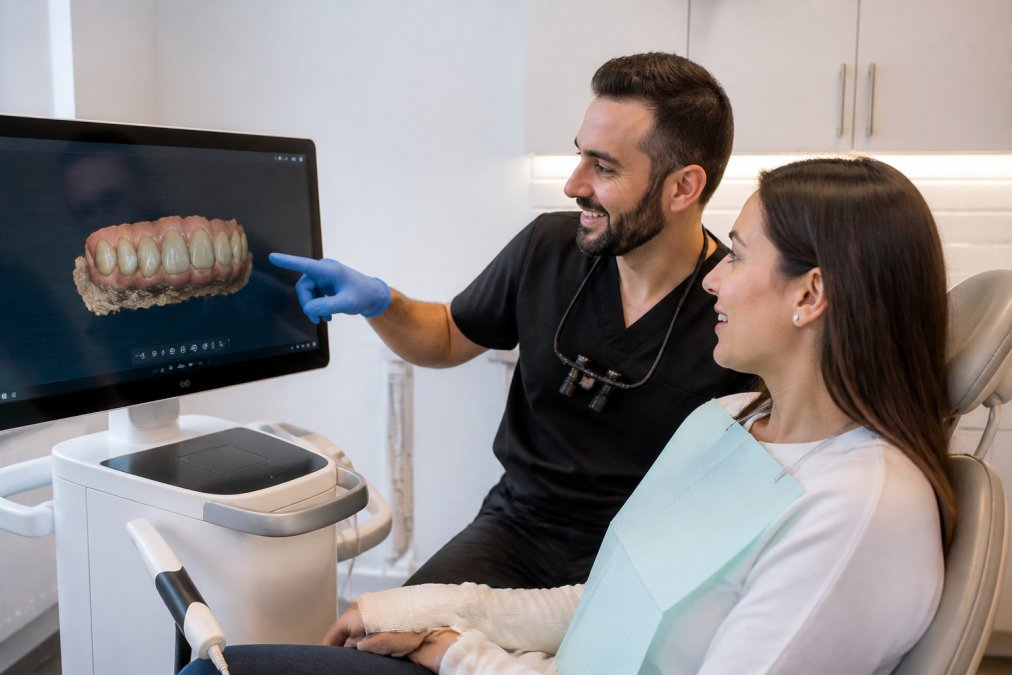
Digital dentistry uses 3D imaging, intraoral scanning, and software-assisted diagnostics to plan and deliver treatment. Its practical benefit is precision: less guesswork, fewer repeat visits, and restorations that fit the first time.
3D Imaging, AI Diagnostics, and Same-Day Crowns
Three technologies drive most of the change:
- 3D imaging and cone beam scans give a full view of teeth, roots, and bone before any treatment begins.
- AI-assisted diagnostics flag early decay and bone loss on X-rays, helping dentists catch problems sooner.
- Same-day crowns use chairside CAD/CAM milling to design, create, and place a ceramic restoration in one appointment, eliminating temporary crowns.
The payoff is fewer appointments and more predictable results, and for nervous patients, seeing the scan on screen makes the plan easier to accept.
Minimally Invasive Dental Procedures: Less Drilling, Faster Recovery
Minimally invasive dentistry preserves as much natural tooth structure as possible, treating the problem without removing healthy enamel you'll never get back.
Dental bonding adds composite resin to repair chips or close small gaps without drilling. Laser dentistry treats gum tissue with less bleeding and faster healing than a scalpel. For early cavities, remineralization and sealants sometimes avoid a filling entirely.
Minimally invasive care often depends on timing. The earlier a problem is caught, the smaller the intervention. That's why routine exams can be important.
Restorative Options: Implants, Bridges, and Full Mouth Reconstruction
Restorative dentistry rebuilds function and appearance when teeth are damaged or missing. The right option depends on how many teeth are involved and the health of surrounding bone and gums.
- Dental implants replace a single missing tooth with a titanium post that fuses to the jawbone, topped with a custom crown. They can help prevent bone resorption and function similarly to natural teeth.
- Dental bridges span a gap by anchoring to neighboring teeth. They're faster to place but don't replace the root.
- Full mouth reconstruction combines multiple treatments, such as implants, crowns, and gum therapy, into one comprehensive plan for patients with widespread damage.
A dental consultation is the only way to know which path fits your case: implants require adequate bone and healthy gums, while bridges may suit patients wanting a shorter timeline.
Managing Dental Anxiety With Modern Comfort Techniques
Dental anxiety is one of the most common reasons adults delay care, and the delay creates bigger problems, advanced decay, gum disease, and more complex treatment. Modern practices treat anxiety as a clinical issue with a clinical solution, not a personal failing. Here's a practical framework for before, during, and after an appointment.
Before the Appointment
- Book the first visit as a consultation only. No treatment, no instruments. You meet the dentist, ask questions, and leave, removing the pressure that drives most avoidance.
- Write down your triggers. Needles, the sound of the drill, the smell of eugenol, feeling unable to breathe, past trauma, naming them lets the team plan around them.
- Say the word 'anxiety' at booking. A practice that takes it seriously will schedule a longer appointment, assign a specific team member, and note it in your chart.
- Visit the office beforehand. Many clinics let you see the waiting and treatment rooms with no obligation. Familiarity reduces the unknown that anxiety feeds on.
- Use a grounding technique on the way in. Box breathing (inhale four counts, hold four, exhale four, hold four) is a simple technique that can be done in the parking lot.
During the Appointment
- Agree on a stop signal. Raising your left hand, for example. Knowing you can pause at any moment can help restore a sense of control.
- Ask for a running commentary. Some patients want every step explained; others want to be told only when a break is coming. Tell the team which you prefer.
- Request topical anesthetic before any injection. It's standard in many modern practices and can reduce the sensation of the needle.
- Use noise and distraction. Headphones with music, a podcast, or white noise block the drill sound that triggers many patients.
- Consider a bite block. It holds your mouth open for you, reducing jaw fatigue and the feeling of losing control.
- Ask about the 'tell-show-do' approach. The clinician explains the step, shows you the instrument, then performs it, a pediatric technique that works just as well for adults.
Sedation Options, From Lightest to Deepest
Sedation is a spectrum; the right level depends on your anxiety, health history, and procedure. (Source: AI-assisted diagnostics)
- Nitrous oxide (laughing gas). Inhaled through a nose mask, takes effect within minutes, wears off quickly, and lets you drive yourself home. Best for mild to moderate anxiety.
- Oral sedatives. Taken before the appointment, they produce a relaxed, sometimes drowsy state. You'll need a ride home and someone to stay with you for several hours.
- Intravenous (IV) sedation. Administered and monitored in the office, it provides a deeper, more controlled level of sedation. You'll need an escort and a full day to recover.
- General anesthesia. Reserved for complex surgical cases or patients who cannot tolerate any other approach. It's performed in a hospital or accredited surgical facility with an anesthesiologist present.
After the Appointment
- Debrief while it's fresh. Note what worked and what didn't. The next visit can be adjusted accordingly.
- Book the next appointment before you leave. Momentum matters. Rebooking before leaving can help maintain momentum for future appointments.
- Reward yourself. A small, deliberate reward after a difficult appointment reinforces the behavior and makes the next one easier.
Costs, Insurance, and Planning Your Treatment
Most guides on modern dental solutions stop at the clinical description and leave you to figure out the bill. Dental care in Canada is largely privately funded, so knowing how to plan, sequence, and pay for treatment matters as much as choosing the procedure.
What Actually Drives the Price
Four variables explain almost every quote you'll receive:
- Procedure complexity. A single filling and a full-arch implant reconstruction sit at opposite ends of the scale, and materials (composite vs. ceramic, titanium vs. zirconia) shift the number further.
- Who performs it. A general dentist, a periodontist, a prosthodontist, and an oral surgeon bill at different rates for overlapping work.
- Where it's done. In-office treatment, a surgical suite, and a hospital setting carry different facility fees.
- Lab work. Custom crowns, bridges, veneers, and implant abutments are fabricated by a dental lab, and lab fees are passed through.
A responsible estimate often comes from a written treatment plan.
How Dental Insurance in Canada Actually Works
There is no universal federal dental benefit that covers routine care for all adults. Coverage comes from three places, often in combination:
- Private insurance, usually through an employer or a professional association. Plans typically cover a percentage of preventive care (often 80-100%), basic restorative work (often 50-80%), and major work like crowns, bridges, and implants (often 50% or less), up to an annual maximum.
- Provincial and territorial programs, which vary widely and generally target children, seniors, and specific low-income groups rather than the general adult population.
- Out-of-pocket payment, which covers whatever the first two don't.
A Practical Sequencing Framework
When several treatments are recommended, the order matters for both your health and your wallet:
- Urgent and active disease first. Pain, infection, and active decay get treated before anything elective.
- Stabilize the foundation. Gum disease and bite problems are addressed before crowns, veneers, or implants, because restorations placed on an unstable foundation fail sooner.
- Restore function. Fillings, crowns, bridges, and implants rebuild what's missing or damaged.
- Cosmetic refinement last. Whitening, bonding, and veneers sit at the end because their shade and shape depend on the final restored structure.
This sequence is often considered clinical best practice and can help spread cost across benefit years, which can be beneficial when you have an annual maximum.
Payment Strategies Worth Asking About
- Staged treatment across calendar years. If your plan resets each January, splitting a large plan across two benefit years can double the amount your insurer contributes.
- In-office payment plans. Many practices offer interest-free or low-interest installment options for treatment above a certain threshold.
- Third-party financing. Health-care financing companies provide longer terms, usually with interest, for larger cases.
- Health Spending Accounts (HSAs). If you're self-employed or your employer offers one, HSA funds can often be used for dental care that insurance won't cover.
- Tax treatment. Under Canada Revenue Agency rules, eligible medical expenses, including many dental costs, can be claimed as a non-refundable tax credit on your return (canada.ca). Keep every receipt.
Questions to Ask Before You Say Yes
- Can I see the itemized treatment plan in writing?
- Which procedures are medically necessary and which are elective?
- Will you submit a pre-determination to my insurer?
- What happens if the treatment needs to be redone, is there a warranty?
- Are there payment plan options, and what are the terms?
Getting answers to these five questions before treatment starts can be an effective way to help avoid financial surprises.
Long-Term Maintenance for Adult Oral Health
Modern treatment outcomes can be supported by consistent hygiene and early detection between visits.
Brush twice daily, floss or use interdental brushes, and keep professional cleanings on schedule. Adults face age-specific challenges: gum recession, dry mouth from medications, and wear from years of grinding. Each one is easier to manage when caught early.
If it's been a while since your last visit, book a comprehensive exam. A fresh baseline is the first step toward a smile you don't have to worry about.
Frequently Asked Questions
What are the latest advancements in dental technology for adults?
Recent advancements include AI-powered diagnostic imaging that helps detect decay earlier, intraoral cameras that show patients what the dentist sees, and same-day crown milling with CEREC technology. Digital radiography reduces radiation exposure compared to traditional film X-rays. These modern dental solutions mean faster appointments, more accurate diagnoses, and better communication about your treatment. Many clinics also use 3D printing for night guards and surgical guides, cutting lab wait times.
Are modern dental procedures less invasive than traditional methods?
In many cases, yes. Minimally invasive dental procedures focus on preserving natural tooth structure. For example, digital impressions replace messy putty trays, and guided implant surgery uses 3D planning to place implants precisely without large incisions. CEREC same-day restorations often require less drilling than traditional crown preparations. That said, not every case qualifies for a minimally invasive approach. Your dentist will assess your specific situation and recommend the least invasive option that still delivers a stable, lasting result.
How do modern dental solutions improve patient comfort?
Comfort improvements come from several directions. Digital X-ray sensors are smaller and faster than film, so you spend less time with something in your mouth. Intraoral cameras let you see what the dentist sees, which reduces uncertainty. Sedation dentistry options, from nitrous oxide to oral sedatives, help anxious patients relax. Minimally invasive techniques mean less drilling and shorter recovery. Even same-day crowns help because you avoid a second appointment and temporary restorations that can feel bulky or loose.
How can adults maintain oral health using modern preventive care?
Modern preventive care starts with regular exams that use digital diagnostics to catch problems early. AI-assisted X-ray analysis can flag decay or bone loss before it becomes visible to the eye. Intraoral cameras document changes over time. At home, electric toothbrushes with pressure sensors and smart flossing tools support daily hygiene. Your dentist may also recommend 3D-printed night guards if you grind your teeth. The goal is to avoid invasive treatment by catching issues when they are small and easier to manage.
Modern dental care has changed, but finding a clinic that combines advanced technology with genuine patient comfort is still the hard part. ALLDENT Family Dental offers same-day emergency care, personalized treatment plans, and modern digital imaging in a calm, family-friendly setting. Whether you need a routine cleaning or a full restorative plan, our team is ready to help. Book your appointment with ALLDENT Family Dental and get a treatment plan built around your goals.