 how-to
Comprehensive Family Dental Clinic Benefits
Table of Contents
- What a Comprehensive Family Dental Clinic Actually Covers
- Preventive Dental Care for Families: Building Lifelong Habits
- Choosing a Family Dentist for Children: What Parents Should Know
- Same-Day Emergency Care and Scheduling Flexibility
- Dental Insurance Coverage for Families: Navigating Your Plan
- Technology and Treatment Planning at a Modern Family Dental Clinic
- How to Evaluate a Family Dental Clinic Before You Book
- Conclusion
Last Updated: August 17, 2026
What a Comprehensive Family Dental Clinic Actually Covers
A family dental clinic delivers oral health care across every life stage, from a toddler's first tooth to a senior's restorative work, all under one roof. When each family member sees a different provider, records scatter, appointment schedules multiply, and no single clinician has the full picture of your household's oral health history. A well-run family dental clinic solves that problem structurally. The benefits include continuity of care, consistent preventive protocols across ages, and a clinical team that knows your family's history, sensitivities, and treatment goals.
Services for Every Age Group Under One Roof
A truly comprehensive family dental clinic handles pediatric exams, sealants, and space maintainers for children; orthodontic assessments and cosmetic dentistry for teens and adults; and periodontal care, dentures, and implant consultations for seniors. This breadth matters because oral health needs shift significantly at different life stages. One trusted clinical relationship from childhood through adulthood means patients don't need to re-establish trust or rebuild their dental history with a new provider.
Centralized Dental Records and Continuity of Care
When your dental history lives in one place, your dentist can track changes in gum health over years, spot patterns in cavity development, and adjust treatment planning accordingly. A clinician who has seen your X-rays annually for a decade has diagnostic context that no new provider can replicate on a first visit. Centralized records also reduce the risk of missed conditions, early cavity detection, gum disease progression, and bite changes are far easier to identify when the clinical team has a longitudinal record to compare against.
Preventive Dental Care for Families: Building Lifelong Habits
Preventive dentistry is the foundation of long-term oral health, and a family dental clinic is uniquely positioned to deliver it consistently across every household member. The goal is to reduce how often problems arise in the first place.
Routine Check-Ups, Cleanings, and Early Detection
Routine check-ups and professional cleanings are the cornerstone of preventive care. Most adults and children benefit from an oral examination and cleaning every six months, though your dentist may recommend a different frequency based on individual risk factors. Early cavity detection is where preventive care pays its most visible dividends, cavities caught in their earliest stages require far less intervention than those identified only when pain develops. Digital imaging makes detection faster and more precise, often identifying issues invisible on standard X-rays. According to the Canadian Dental Association's preventive care guidance, proactive care significantly reduces the need for complex restorative procedures later.
The same principle applies to periodontal health. Gum disease is progressive and largely symptom-free in its early stages. A clinical team monitoring your gum health consistently is far more likely to catch early inflammation before it advances to periodontitis.
Oral Hygiene Education That Sticks
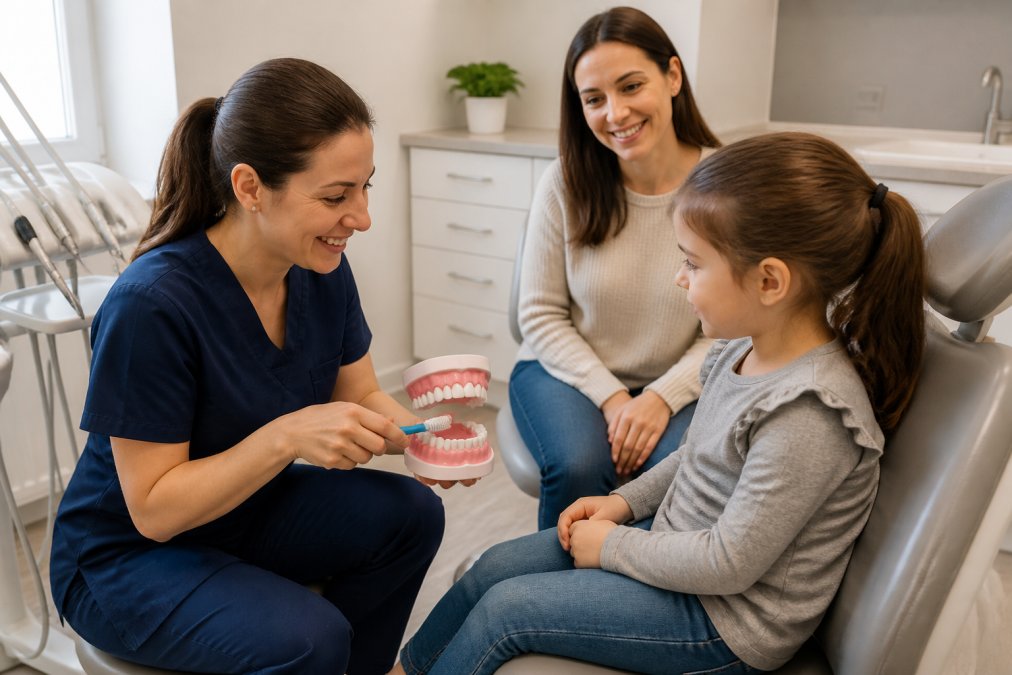
Oral hygiene education is most effective when delivered consistently, age-appropriately, and in a clinical environment the patient trusts. A family dental clinic that sees your children from a young age can build on that education year over year, reinforcing technique as dexterity develops. For adults, education often shifts toward managing specific risks like sensitivity, gum recession, or medication side effects. A clinician who knows your history can tailor guidance directly rather than delivering generic advice.
Choosing a Family Dentist for Children: What Parents Should Know
Choosing a family dentist for children is one of the most consequential decisions a parent makes for their child's long-term health. A child's early dental experiences shape their attitude toward oral care for decades.
Pediatric Dental Services and the Transition to Adult Care
Pediatric dental services within a family practice typically include first dental visits, fluoride treatments, sealants, and monitoring of eruption patterns. One critical advantage: the transition from pediatric to adult dental care. When a child seen by a pediatric-only practice turns 18, they often face an abrupt handoff to an entirely new provider. At a family dental clinic, that transition is seamless. The same clinical team, records, and trust remain. Wisdom tooth development, early gum health baselines, and bite patterns established in adolescence are all relevant context for adult treatment planning, context that's lost when changing providers.
Managing Dental Anxiety for Kids and Adults
Dental anxiety is more common than most people admit. For children, fear of the unknown is the primary driver. For adults, it's often rooted in a previous painful experience. A family dental clinic that takes anxiety seriously creates an environment where both groups can receive care without dread. Effective anxiety management involves clear communication about what will happen, a calm physical environment, a clinical team that doesn't rush, and genuine willingness to adjust based on patient feedback.
Same-Day Emergency Care and Scheduling Flexibility
Emergency dental care availability is a practical test of how much a clinic prioritizes its patients. A cracked tooth or sudden severe pain don't schedule themselves for convenient hours. A family dental clinic offering same-day emergency appointments means your family doesn't end up in a hospital emergency room for a dental problem.

Scheduling flexibility matters beyond emergencies. Families with multiple members in care need appointment coordination that fits around school and work. A clinic offering early morning or evening slots reduces the friction that causes families to delay or skip appointments.
| Situation | What to Expect at a Family Clinic | Why It Matters |
|---|---|---|
| Sudden tooth pain | Same-day assessment and pain relief | Avoids ER visits and delays |
| Lost or broken crown | Prompt re-cementation or temporary cover | Prevents further damage |
| Dental anxiety (child) | Adapted appointment pace and environment | Builds trust, not avoidance |
| Multi-member scheduling | Coordinated family appointments | Reduces missed appointments |
| Transitioning from pediatric care | Continuous records, no re-registration | Preserves clinical history |
Dental Insurance Coverage for Families: Navigating Your Plan
Dental insurance coverage for families is confusing, and many families leave money on the table simply because they don't understand their plan. A family dental clinic with experienced billing staff can make a significant difference.
Most private dental plans in Canada cover a portion of preventive services at a higher reimbursement rate than restorative or cosmetic procedures. Understanding what your plan covers, at what frequency, and up to what annual maximum helps you plan care strategically. According to the Canadian Life and Health Insurance Association's dental coverage overview, most group dental plans include basic preventive and restorative coverage, though specifics vary by employer plan.
The Canadian Dental Care Plan (CDCP) has expanded access to dental services for eligible Canadians who meet specific income thresholds and don't have private coverage. Check the Government of Canada's Canadian Dental Care Plan information for current eligibility criteria and covered services, since details are subject to change.
Before registering, confirm that the practice accepts your insurance, submits claims directly on your behalf, and has experience with both private plans and the CDCP.
Technology and Treatment Planning at a Modern Family Dental Clinic
Modern technology in a family dental clinic is a clinical advantage, not a luxury. Digital imaging produces clearer diagnostic images at lower radiation exposure than film-based X-rays. Intraoral cameras let patients see exactly what the dentist sees, improving understanding and informed consent. For families, this matters practically, a child's first set of X-rays establishes a baseline, and digital records make year-over-year comparison simple. For adults considering orthodontic treatment like Invisalign, digital scanning replaces traditional impressions and feeds directly into treatment planning software. Better diagnostic tools enable minimally invasive techniques, meaning less drilling, shorter appointments, and faster recovery, particularly relevant for anxious patients. According to the Canadian Dental Hygienists Association's oral health resources, patient education and modern diagnostic tools are central to contemporary preventive dentistry practice.
How to Evaluate a Family Dental Clinic Before You Book
Most people choose a dentist based on location and whether the clinic is accepting new patients. That's a reasonable starting point, but it leaves out the factors that determine whether the relationship works long-term.
Here's a practical evaluation checklist before booking your family's first appointment:
- Does the clinic offer services for all ages in your household, including young children and seniors if applicable?
- Can the practice accommodate same-day emergency appointments?
- Does the clinic accept your dental insurance plan and assist with direct billing?
- Is the clinic familiar with the Canadian Dental Care Plan if you are eligible?
- Does the clinical team have experience managing dental anxiety in both children and adults?
- Are digital imaging and modern diagnostic tools part of the standard workflow?
- Can you access your dental records and treatment history easily?
- Does the clinic offer flexible scheduling, including early or late appointments?
- What is the process for transitioning a child patient into adult care within the same practice?
- Are patient reviews and before-and-after examples available for cosmetic or restorative work?
The real difference between a clinic that works for your family and one that doesn't often comes down to how the first appointment feels. Does the team take time to understand your history and concerns? Do they explain findings clearly? Are children treated with patience rather than efficiency? Those signals are visible from visit one.
Oral health for a whole household is genuinely complex to coordinate, and most families manage it more reactively than they should. ALLDENT Family Dental is built around the idea that comprehensive, proactive care delivered in a calm and welcoming environment produces better long-term outcomes for patients of all ages. With same-day emergency care, personalized treatment plans, digital imaging, and a clinical team experienced in managing dental anxiety, the practice is designed to be the single provider your family stays with for the long term. Book your appointment with ALLDENT Family Dental and give your family's oral health the continuity it deserves.
Frequently Asked Questions
What services are included in comprehensive family dental care?
A comprehensive family dental clinic typically covers preventive exams, dental cleanings, oral hygiene education, cavity treatment, gum health monitoring, restorative procedures, pediatric dentistry, and emergency care. Many practices also offer cosmetic treatments such as teeth whitening and Invisalign. The goal is to handle the full spectrum of oral health needs for every family member, from toddlers to seniors, without requiring referrals to multiple separate offices for routine care.
How often should children and adults visit a family dental clinic?
Most dental associations recommend check-ups and professional cleanings every six months for both children and adults. Children with developing teeth or higher cavity risk may benefit from more frequent visits, while adults with good periodontal health may be placed on a schedule tailored to their specific needs. Your dentist will recommend an appointment frequency based on your family's oral health history, risk factors, and treatment plans, there is no single schedule that fits every household.
Does a comprehensive dental clinic handle emergency dental care?
Yes. A full-service family dental clinic should offer same-day or urgent appointments for dental emergencies such as severe toothaches, chipped or knocked-out teeth, lost fillings, and swelling. Visiting an emergency room for dental pain typically results in pain management only, not treatment. Having an established relationship with a family dentist means the clinic already has your dental records on file, which speeds up diagnosis and care when every minute matters.
How does dental insurance coverage work for families at a dental clinic?
Dental insurance coverage for families in Canada varies by plan, but most employer-sponsored and private plans cover a portion of preventive services, such as exams and cleanings, at a higher rate than restorative or cosmetic work. The Canadian Dental Care Plan (CDCP) extends coverage to eligible Canadians who meet income and insurance criteria. A good family dental clinic will help you understand what your plan covers, submit claims on your behalf, and discuss payment options for any out-of-pocket costs. Always confirm coverage details directly with your insurer.
This article was written using GrandRanker